 Contact
 Help
Help






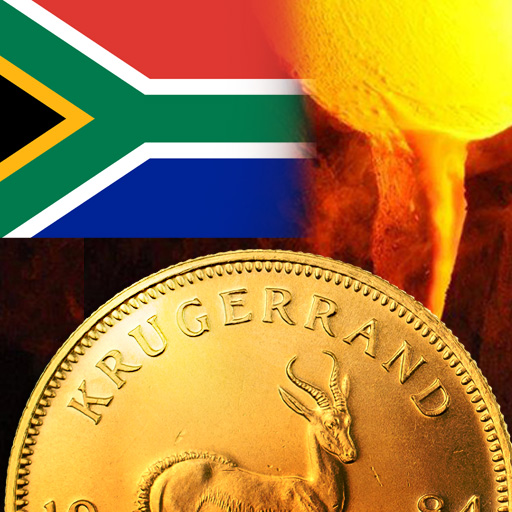
Rand Refinery: Africa’s Only LBMA-Accredited Gold Refinery



Rand Refinery is a precious metals refinery in Germiston, South Africa. It is located on the eastern edge of Johannesburg and inside the Witwatersrand goldfield that gave South African gold mining its name. It was registered in 1920 by what was then the Chamber of Mines of South Africa, now the Minerals Council, and began refining the following year. It is still owned by five South African gold mining companies, and it remains the only refinery on the African continent accredited by the London Bullion Market Association, for gold and for silver.
Rand Refinery is one of seven refiners the LBMA appoints as Good Delivery referees, the small group trusted to assay other refineries’ work, a role it has held since 2003. It makes the blanks for the Krugerrand, the first modern bullion coin, first struck in 1967 and still among the most widely held gold coins in the world.
The gold it refines has changed far more than the refinery has. In the year to August 2025 it put 217 tonnes of gold through the refinery across nearly 4,600 customer deposits, and only 40% of that came from South African mines. The rest arrived from across the continent and beyond, from 19 countries in all. South Africa produced around two thirds of the world’s gold in 1970 and roughly 100 tonnes in 2024, so the refinery has outlasted the mining industry that built it by refining other people’s gold instead.
This guide covers who owns Rand Refinery and how it came about, what it produces and how the Krugerrand is actually made, how to check that a Rand Refinery bar or a Krugerrand is genuine, how Krugerrand premiums compare with other gold coins, and what buying and selling them involves.
Highlights
- A precious metals refinery, smelter and fabricator at Germiston near Johannesburg, registered in 1920 by South Africa’s gold mining companies and still owned by five of them.
- The only LBMA-accredited precious metals refiner on the African continent, with gold good delivery accreditation since around 1921 and silver from before 1959.
- One of seven LBMA Good Delivery referees worldwide, a role it has held since 2003, and the manufacturer of the certified reference materials the LBMA itself uses.
- Refined 217 tonnes of gold in the year to August 2025, sourced from 19 countries, with only 40% of it coming from South African mines.
- Manufactures the gold blanks for the Krugerrand, which is struck by the South African Mint and distributed by Prestige Bullion, a joint venture between the two.
Who Is Rand Refinery?
Rand Refinery is a precious metals smelter, refinery and fabricator on a single high-security site at Germiston, about 16 kilometres east of Johannesburg and inside the Witwatersrand goldfield. All three of those functions matter. Most refineries buy in material that has already been smelted, whereas Rand takes doré and low-grade by-products running anywhere from 10% to 99% gold content, smelts it, refines it, and then fabricates the result into cast bars, minted bars, granules, wire and coin blanks without the metal leaving the site.
In the year to August 2025 it put 217 tonnes of gold through the refinery across nearly 4,600 customer deposits, down from 234 tonnes the year before, while its smelter took in 1,277 tonnes of gross material. It employs around 505 people and sources from 19 countries. Rand puts its annual gold sourcing at 220 to 250 tonnes, of which it says 99.6% comes from responsible mining operations across Africa.
A Refinery Owned by Its Miners
Rand Refinery exists because South Africa had no refinery of its own. Before 1920, crude bullion from the Witwatersrand was shipped to London to be refined, and the gold mining companies were paying for the privilege. In 1920 they registered a refinery of their own through what was then the Chamber of Mines of South Africa, today the Minerals Council, and it began refining the following year.
That structure has survived for more than a century. Rand Refinery is still privately owned by five South African gold mining companies:
| Shareholder | Holding |
|---|---|
| AngloGold Ashanti | 42.41% |
| Sibanye Gold | 33.15% |
| DRDGold | 11.30% |
| Harmony Gold Mining | 10.38% |
| Gold Fields Operations | 2.76% |
It is an unusual arrangement for a refinery, and it explains a good deal about how the business behaves. Rand acts as the refining and marketing agent for its owners’ output, which is why its history is so tightly bound to South African mining, and it has had to look well beyond them as that mining has declined. South African mine deposits accounted for just 40% of the gold it refined in 2025. The rest came from mines elsewhere in Africa and further afield, with deliveries from African customer mines falling 8.8% during the year on disruption centred in Mali.
LBMA Accreditation and the Referee Panel
Rand Refinery’s gold has been accredited as good delivery for the London market since around 1921, which makes it one of the oldest continuous entries on the list, and its silver accreditation predates 1959. It is the only LBMA-accredited precious metals refiner on the African continent, for gold and for silver both, and it is the only African entry on either current list.
It also sits on the LBMA’s panel of Good Delivery referees, the small group of refiners that assess applicants to the list, provide technical guidance, and assay sample bars submitted by other refineries. Rand has held that appointment since 2003. The panel held five members for decades before the LBMA expanded it to seven in March 2025, and the others are PAMP, the Perth Mint, Metalor, Argor-Heraeus, Tanaka and Germany’s Agosi.
Rand Refinery actually manufactures the certified reference materials the LBMA itself uses, gold wires and silver discs against which other laboratories calibrate. When another refinery checks its own assay work, it may well be checking it against metal made in Germiston.
Beyond London, its bars are accepted for delivery on COMEX, where it has been a member since 1974, and on the Tokyo Commodity Exchange since 1993. It gained Shanghai Gold Exchange accreditation in 2015, joined the Singapore Bullion Market Association in 2020, and became an accredited UAE Good Delivery refiner in 2025, the same year it fully implemented the ISO 24018 kilobar standard. Its laboratory is accredited to ISO/IEC 17025.
In February 2026 it took that role a step further, entering a partnership to provide technical, operational and commercial supervision to Ghana’s Gold Coast Refinery in Accra, connected to Ghana’s programme for refining artisanally mined gold. The LBMA’s chief executive said publicly that she hoped it would be the first of many such arrangements.
What Rand Refinery Produces
Rand Refinery’s output splits between the wholesale market and the retail one, and the wholesale half is by far the larger. Most of what leaves Germiston is large cast bars destined for bullion banks, central banks and exchanges, along with gold granules and karat alloys for the jewellery trade, gold wire for industry, and the certified reference materials the LBMA uses. Investment bars and coin blanks are the part a private buyer sees.
The fabrication arm is unusually broad for a refinery, which is a consequence of the integrated site. Because the smelting, refining and fabrication all happen in one place, gold can go from doré to a finished minted bar without changing hands, and Rand has used that to become a significant supplier of kilobars and 100 gram cast bars since the mid-1990s. In 2025 it fully implemented ISO 24018, the international standard for kilobars.
Cast and Minted Bars
| Format | Weights and finenesses produced |
|---|---|
| Cast gold | 400 oz London Good Delivery at 99.5, 1 kg at 99.5 and 99.99, 100 g at 99.9 and 99.99 |
| Minted gold | 10 g, 20 g, 1 oz, 50 g and 100 g at 99.99, with 500 g and 10 oz on special request |
| Cast silver | 1,000 oz Good Delivery bars |
Rand Refinery makes the same kilobar at two purities because different markets want different things: 99.5% for India and the Middle East, 99.99% for the Far East. A refinery that serves the whole of Africa and sells into Asia has to make both, and it is a useful reminder that “999.9” is a market convention rather than a universal standard of quality.
Minted bars are supplied in secure tamper-evident packaging, and in 2025 Rand reported unprecedented international demand for them. It also produces a 1 oz themed silver minted bar on request, which is where the occasional collectable pieces come from. In South Africa itself, minted bars only became available to private investors after a change in legislation, and the domestic range is restricted to 10 g, 50 g and 100 g gold.
In 2026 Rand introduced RandSure, a minted bar range in 10 g, 20 g, 1 oz, 50 g and 100 g made from gold blended exclusively from its South African shareholder mines. The bars carry an elephant design with fine security lines worked into it, individual serial numbers, and packaging with a tamper-evident seal and a QR code. The verification system behind that code is covered in the next section.
Rand Refinery and the Krugerrand
The Krugerrand is the product Rand Refinery is known for, and the way it is made is more divided than most people assume. Rand Refinery manufactures the blanks. The South African Mint, which is wholly owned by the South African Reserve Bank, strikes the coins. Prestige Bullion, a joint venture between the two, distributes them worldwide. No single organisation makes a Krugerrand.
The coin was conceived in the 1960s as a way of marketing South African gold internationally, and the first 1 oz Krugerrand was struck in 1967. It was the first modern bullion coin, sold on the value of its gold content rather than a face value, and every sovereign bullion coin that followed, the Maple Leaf, the Eagle, the Britannia, the Philharmonic, took the idea from it. Fractional sizes in 1/2, 1/4 and 1/10 oz arrived in 1980.
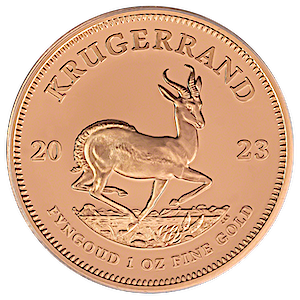
It is a 22 karat coin, 91.67% gold with copper alloyed in for hardness, which is the single most misunderstood thing about it. A 1 oz Krugerrand does not weigh one troy ounce. It weighs 1.0909 troy ounces gross and contains exactly one troy ounce of fine gold, the extra weight being the copper. That is deliberate. Krugerrands were designed to be handled and circulated, and the copper makes them far more resistant to scratching and denting than a 99.99% (24 karat) coin, at the cost of a slightly reddish tone and a larger diameter.
Rand also makes the blanks for South Africa’s Big Five gold bullion coin series, and the Krugerrand itself was extended into other metals for its fiftieth anniversary in 2017, when silver and platinum versions appeared. The silver Krugerrand has been produced as an ongoing bullion coin since 2018, in 1 oz at 99.9% fine.
At BullionStar we stock the 1 oz, 1/2 oz and 1/10 oz gold Krugerrand in assorted years, and the silver Krugerrand across recent dates. Browse our gold coins and silver coins ranges. We do not routinely stock Rand Refinery gold bars, which is common among dealers outside Africa, since most of the refinery’s bar output goes to the wholesale market and most retail demand for the brand arrives looking for the coin.
How to Identify a Genuine Rand Refinery Bar or Krugerrand
A Rand Refinery bar is a modern product with modern security behind it, while a Krugerrand is a coin that has been struck every year since 1967 and circulates in enormous numbers, with no digital verification attached to it at all. More Krugerrands are in circulation than all other gold bullion coins combined, and anything that numerous, that liquid and that widely recognised is an obvious target for counterfeiters. The good news is that the Krugerrand’s own specification makes it unusually easy to check with a scale and a pair of calipers.
Checking a Krugerrand
Start with the thing most people get wrong. A 1 oz Krugerrand does not weigh one troy ounce. It is 22 karat gold, 11 parts gold to 1 part copper, so it contains exactly one troy ounce of fine gold and weighs 33.93 grams in total. If a coin sold to you as a 1 oz Krugerrand weighs 31.1 grams, it is not a Krugerrand.
| Krugerrand | Diameter | Thickness | Fine gold | Total weight |
|---|---|---|---|---|
| 1 oz | 32.77 mm | 2.84 mm | 31.10 g | 33.93 g |
| 1/2 oz | 27.00 mm | 2.215 mm | 15.55 g | 16.97 g |
| 1/10 oz | 16.50 mm | 1.35 mm | 3.11 g | 3.39 g |
Comparing a suspect coin against those dimensions is the first and simplest check to carry out. Gold alloyed with copper is dense, and no cheap substitute matches it, so a counterfeit that gets the diameter and thickness right will be wrong on weight, and one that gets the weight right will be too thick or too wide. Calipers accurate to a tenth of a millimetre and a scale accurate to a hundredth of a gram will catch almost anything.
After that, look at the coin:
– The colour. The copper gives a genuine Krugerrand a warm, slightly reddish tone quite unlike the lemon yellow of a 99.99% coin. Once you have seen the two side by side it is hard to miss.
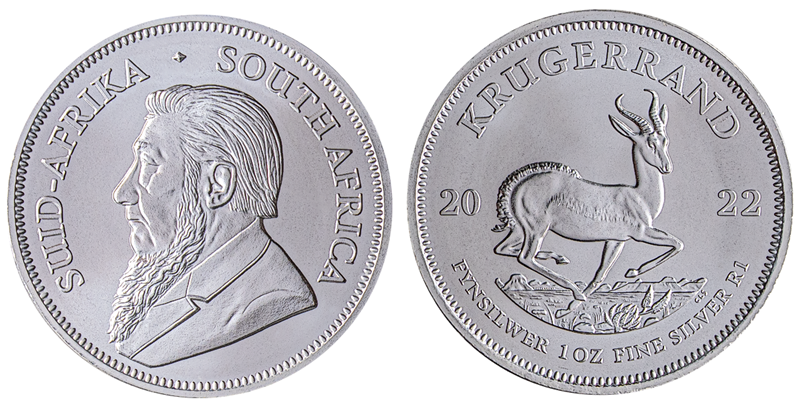
– The reverse carries the springbok, the year, and the denomination in both languages, “FYNGOUD 1 OZ FINE GOLD”, with the initials CLS for the designer Coert Laurens Steynberg.
– The obverse shows Paul Kruger with “SUID-AFRIKA SOUTH AFRICA” around the rim.
– A magnet. Both gold and copper are non-magnetic, so any magnetic response means the coin is likely fake. A coin that fails to react proves nothing, since lead and tungsten are non-magnetic too, which is why the weight and dimensions matter more.
Checking a Rand Refinery Bar
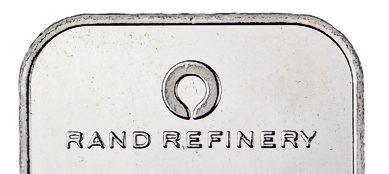
The bar mark tells you the era it was produced. Since 2011 Rand Refinery bars have carried a circular brand mark representing a pouring crucible. Before that the mark was an encircled springbok head. Both are genuine, and a springbok-head bar is simply an older one, but a bar claiming a recent production date with the wrong mark for that date is a problem.
Beyond the mark, a genuine bar carries the official Rand Refinery stamp with the weight and fineness, and minted bars are supplied in secure tamper-evident packaging that should be intact.
The RandSure minted bar range, introduced in 2026, goes considerably further. The bars carry an elephant design with fine authentication lines worked into the surface, visible and tactile, and each one is individually serialised. The packaging has an African contour watermark, a tamper-evident seal and a QR code, and Rand publishes the bar dimensions to a tolerance of about 0.025 mm, so measurement is a meaningful check here too.
The QR code leads to two certificates rather than one: a digital certificate of assurance confirming the bar’s identity, and a certificate of provenance tracing the gold back through the supply chain on the aXedras blockchain platform, which the LBMA and World Gold Council support. Rand’s separate RandTrack app adds image recognition, checking the product and its packaging against known security features and issuing a credit-card-sized digital certificate carrying the product number, weight, purity, batch number, production date and country of manufacture to the ISO 24018 standard.
How Rand Refinery’s Verification Compares
| Refinery | Who can verify, and how |
|---|---|
| Rand Refinery | The owner, by QR code or image recognition, on RandSure minted bars |
| PAMP | The owner, using the Veriscan app on a compatible bar |
| Argor-Heraeus | The owner, by eye, on a Kinebar |
| Royal Canadian Mint | A dealer only, using Bullion DNA equipment |
| Heraeus | Markings and physical checks, as with most refiners |
Rand Refinery’s verification system appears to be the most complete system of the five, since it is the only one that verifies the packaging as well as the metal and the only one that returns provenance rather than a yes or no. The honest caveat is that none of it applies to a Krugerrand. The verification sits on Rand’s own minted bar range, not on the coin, so if you are buying Krugerrands the checks are the physical ones above.
Where any doubt remains, have the coin or bar tested. Our guide on how to test gold covers the methods, from density and dimensions through to ultrasound and X-ray fluorescence.
Rand Refinery Prices and Premiums
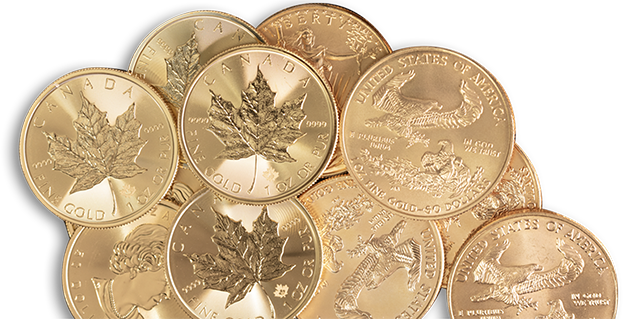
A Krugerrand is priced from the live gold price plus a premium covering minting, distribution and dealer margin. The table below compares the Krugerrand against other 1 oz gold bullion coins.
The Krugerrand Against Other 1 oz Gold Coins
| 1 oz gold coin | Premium over spot |
|---|---|
| Britannia | 3.8% |
| Kangaroo | 3.8% |
| Maple Leaf | 4.0% |
| Philharmonic | 4.3% |
| Krugerrand | 4.3% |
The whole field spans about half a percentage point, so the choice between these coins is barely a price decision at all. What is worth knowing is that our buy-back price is identical across all five: on the way out we are buying one troy ounce of fine gold, and the design on it is irrelevant. The Krugerrand sits at the top of that narrow range going in, which its liquidity and worldwide recognition arguably earn back.
The GST Difference in Singapore
There is one further cost that does not appear in any premium table, and for a Singapore-delivered buyer it dwarfs everything above.
Singapore exempts Investment Precious Metals from GST, but gold has to be at least 99.5% pure to qualify. A Krugerrand is 22 karat, 91.67% gold, so it does not meet the threshold. We sell it under the Gross Margin Scheme instead, which means GST applies on Singapore deliveries, though not on exports. Every other coin in the table above, and every gold bar we sell, is 99.9% or finer and carries no GST at all.
If you are buying a Krugerrand for export, or because you want that particular coin, the half point of extra premium is neither here nor there. If you are buying gold to hold in Singapore and the Krugerrand simply happened to be the coin you had heard of, one of the 99.99% coins will cost you materially less for the same ounce of gold.
The 99.9% silver Krugerrand is not affected, since it clears the purity threshold for silver and is sold with no GST.
Fractional Krugerrands cost considerably more per ounce of gold, because the minting cost barely changes while the gold content falls. At the time of writing the half ounce coin carried a 12.6% premium and the tenth ounce 38.4%, against 4.3% for the one ounce. Fractional premiums are higher on most coins, not just on the Krugerrand.
You can check today’s prices on our gold price and silver price pages, and current buy-back rates for every product on our sell gold and silver page.
Frequently Asked Questions
What is Rand Refinery?
Rand Refinery is a precious metals refinery, smelter and fabricator at Germiston in South Africa, registered in 1920 by the country’s gold mining companies and still owned by five of them. It refined 217 tonnes of gold in the year to August 2025, sourced from 19 countries, and it is the only refinery on the African continent accredited by the LBMA. It is best known outside the industry as the maker of the Krugerrand’s gold blanks.
Does Rand Refinery make the Krugerrand?
Partly. Rand Refinery refines the gold and manufactures the coin blanks, the South African Mint strikes the coins, and Prestige Bullion, a joint venture between the two, distributes them worldwide. So a Krugerrand is a Rand Refinery product and a South African Mint product at the same time, which is why you will see both names attached to it.
Do you pay GST on Krugerrands in Singapore?
Yes. A Krugerrand is 22 karat, 91.67% gold, which falls below the 99.5% purity threshold for GST-exempt investment precious metals in Singapore, so we sell it under the Gross Margin Scheme and GST applies on local delivery, though not on exports. The 99.9% silver Krugerrand is exempt, as are all our 99.9% and finer gold coins and bars.
Is Rand Refinery LBMA accredited?
Yes, for both metals. Its gold has been accredited as good delivery for the London market since around 1921 and its silver from before 1959, making it the only African refiner on either current list. It has also been one of the LBMA’s Good Delivery referees since 2003, one of seven refiners worldwide trusted to assay other refineries’ work, and it manufactures the certified reference materials the LBMA itself uses. Beyond London its bars are accepted on COMEX and TOCOM, and it holds Shanghai Gold Exchange and, since 2025, UAE good delivery accreditation.
Where is Rand Refinery located?
In Germiston, in Gauteng province, about 16 kilometres east of Johannesburg and inside the Witwatersrand goldfield that gave South African gold mining its name. Everything happens on that one site: smelting, refining, assaying and the fabrication of bars, granules, wire and coin blanks. The location was chosen in 1920 because it sat in the middle of the goldfields and had good rail connections.
Can I sell Rand Refinery bars back?
Yes. We quote a live buy-back price on Rand Refinery bars and on Krugerrands whether or not you bought them from us, and we buy by weight and metal rather than by brand. That is worth knowing if you hold Krugerrands: at the time of writing our buy-back on a 1 oz Krugerrand was exactly the same as on a 1 oz Maple Leaf, Britannia, Philharmonic or Kangaroo, because on the way out we are buying one troy ounce of fine gold. Current rates for every product are on our sell gold and silver page.
Buying and Selling Rand Refinery Bullion
Rand Refinery does not sell to the public. Its cast bars go to bullion banks, central banks and exchanges, its granules and wire go to industry, and its coin blanks go to the South African Mint, so the way its metal reaches a private buyer is through a dealer and, nine times out of ten, in the form of a Krugerrand.
At BullionStar that means the 1 oz, 1/2 oz and 1/10 oz gold Krugerrand in assorted years, and the 1 oz silver Krugerrand across recent dates. We do not routinely stock Rand Refinery bars, which is normal for dealers outside Africa. Every product page shows the live buy price, the sell price and the premium over spot at the same moment, so you can see the round trip before you commit rather than afterwards.
Where you take delivery matters more for this coin than for most. Because a Krugerrand is 22 karat it falls below Singapore’s purity threshold for GST-exempt Investment Precious Metals, so GST applies on Singapore deliveries, though not on exports. If you want the Krugerrand specifically, that is simply part of the cost of the coin. If what you want is gold held in Singapore, a 99.99% gold coin or gold bar achieves the same thing without it, and at a slightly lower premium too. The silver Krugerrand is unaffected, since it clears the threshold for silver.
Bars and coins bought from us can be collected in person at our Bullion Center in Singapore, shipped to most countries, or left in vault storage in Singapore, where they are held as your allocated property and can be audited or withdrawn at any time.
When you come to sell, we buy Rand Refinery bars and Krugerrands back at a live quoted price, whether or not you bought them from us, by weight and metal rather than by brand. You can track what your holding is worth against the live gold price and silver price at any time.
Subscribe to Gold University Articles
Copyright Information: BullionStar permits you to copy and publicize articles or information from the BullionStar Gold University provided that a link to the article's URL or to https://bullionstar.com is included in your introduction of the article or blog post together with the name BullionStar. The link must be target="_blank" without re="nofollow". All other rights are reserved. BullionStar reserves the right to withdraw the permission to copy content for any or all websites at any time.