 Contact
 Help
Help







The Austrian Mint: Austria’s National Mint Since 1194



The Austrian Mint is Austria’s national mint, based at Am Heumarkt in central Vienna and trading as Münze Österreich AG. It traces its origins to 1194, when Richard the Lionheart, captured on his way home from the Third Crusade, was ransomed to Duke Leopold V of Austria for twelve tonnes of silver. Leopold struck coins with the silver, and the Mint has counted its age from that moment ever since, marking its 830th anniversary in 2024.
Unusually, it is owned by a central bank. Münze Österreich is a wholly owned subsidiary of the Oesterreichische Nationalbank, which is in turn wholly owned by the Republic of Austria. The Perth Mint answers to a state government and the Royal Canadian Mint is a federal Crown corporation, but the Austrian Mint sits directly beneath the institution that issues its country’s money.
It is also narrower than those two, and smaller. Production and administration share a single building in Vienna staffed by fewer than two hundred people, and there is no refinery. The Austrian Mint buys already refined metal from accredited refiners and strikes it into coins, and its gold bars are manufactured for it in Switzerland by Argor-Heraeus and PAMP. It is best known for the Vienna Philharmonic range.
This page covers who owns the Austrian Mint and how it is structured, why it mints without refining, the Philharmonic range across all three metals, how to tell a genuine coin from a counterfeit, how its premiums compare with rival sovereign coins, and what buying Philharmonics involves from outside Europe.
Highlights
- The Austrian Mint, located in Vienna, is one of the oldest mints in Europe, tracing its origins to 1194.
- The Mint, which is officially called Münze Österreich, is a fully-owned subsidiary of Austria’s central bank, Oesterreichische Nationalbank (OeNB).
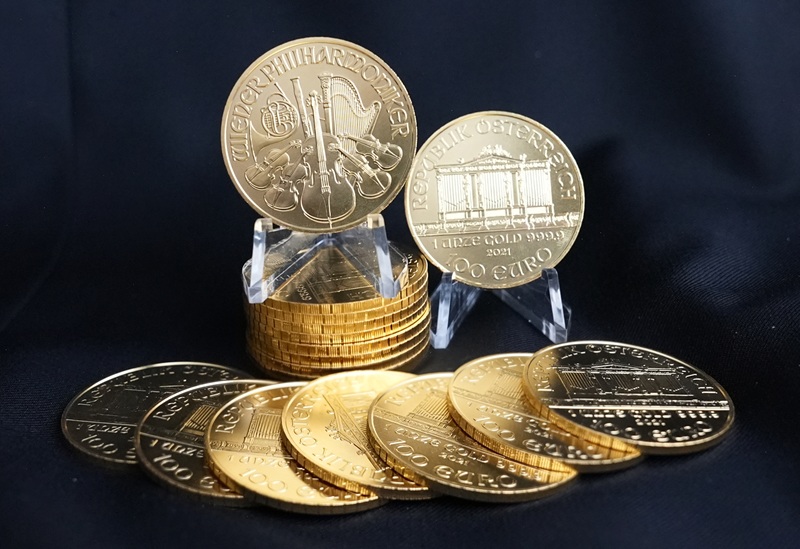
- The Austrian Mint produces the world-famous Philharmonic series of bullion coins which celebrate the Vienna Philharmonic orchestra.
- The Philharmonic is produced in gold, silver and platinum. The Mint also strikes Austria’s circulation coinage, collector coins, and coin blanks supplied to mints around the world.
- The Austrian Mint is not listed on the LBMA Good Delivery list, but its gold bars are produced by Argor-Heraeus and PAMP, who are both LBMA listed.
Who Is the Austrian Mint?
Münze Österreich AG is Austria’s national mint, working from a single building at Am Heumarkt 1 in Vienna, where production and administration sit side by side. Its statutory job is to supply Austria with its euro and cent coinage, and in 2025 it delivered 55.7 million circulating coins. Everything else it does sits on top of that obligation: the Vienna Philharmonic in gold, silver and platinum, gold bars, historic trade coins, collector and commemorative issues, medals, and gold and silver blanks supplied to other mints around the world.
It is a small company by the standards of its peers. It employed an average of 179 staff in 2025, against roughly 690 at the Perth Mint and 1,173 at the Royal Canadian Mint, both of which also run refineries across two sites each.
Turnover in 2025 was €2,147.2 million, against €871.5 million the year before. That looks like an extraordinary year, and in one sense it was, but the figure needs reading carefully. The Mint deliberately hedges out precious metal price and currency risk, taking on delivery obligations only once a product price and its metal cost are fixed, so revenue moves with the gold price rather than with the business. Operating profit was €42.4 million, slightly below 2024’s €43.4 million, and net profit fell from €48.1 million to €29.1 million. Revenue nearly tripled and the company made less money.
Across bars, bullion coins and trade coins, the Mint sold 531,000 ounces of investment gold in 2025, a little over 16 tonnes, along with 3.9 million ounces of silver and 22,000 ounces of platinum.
Owned by Austria’s Central Bank
Münze Österreich is a wholly owned subsidiary of the Oesterreichische Nationalbank, which is itself wholly owned by the Republic of Austria. The mint was transferred to the central bank in 1988 and incorporated as a public company the following year.
That is a genuinely unusual arrangement. The Perth Mint is a state government trading enterprise, the Royal Canadian Mint a federal Crown corporation, and the Royal Mint and the US Mint both answer to their respective treasuries. The Austrian Mint answers to the institution that issues the country’s money, and the relationship is operational rather than nominal. The Mint’s investment risk controlling is carried out by the central bank’s own experts.
It also carries an obligation most bullion producers do not. Under Austria’s coinage act the Mint is required to redeem circulating coins it has issued against payment of their face value, which is a liability no privately owned refiner takes on.
A Mint, Not a Refinery
The Perth Mint and the Royal Canadian Mint both operate their own refineries, taking in doré from mine sites and turning it into refined metal. The Austrian Mint does not refine at all. It buys metal that has already been refined, from refiners accredited by the London Bullion Market Association, and its own work begins after that: casting, rolling, blanking and striking.
Its gold bars are manufactured for it in Switzerland by Argor-Heraeus and PAMP, which is why a Münze Österreich bar carries a Swiss producer’s melter and assayer mark rather than an Austrian one.
The consequence is that Münze Österreich itself holds no LBMA Good Delivery accreditation, because that accreditation is for refiners. Austria has no accredited refinery at all.
That is a structural fact rather than a quality concern, and it is worth separating the two. The metal in a Philharmonic comes from accredited refiners, and the bars are made by two of the most respected names on the Good Delivery list. But the Mint’s own wording can blur the distinction. Its FAQ says its bars meet the LBMA’s Good Delivery standard, which is a claim about the specification and about its Swiss producers, not about accreditation the Mint holds.
What the Mint does hold is certification to ISO 9001, 14001, 45001 and 50001, and it states compliance with the EU conflict minerals regulation and with the OECD’s due diligence guidance for minerals from conflict-affected and high-risk areas.
From Richard the Lionheart to Münze Österreich AG
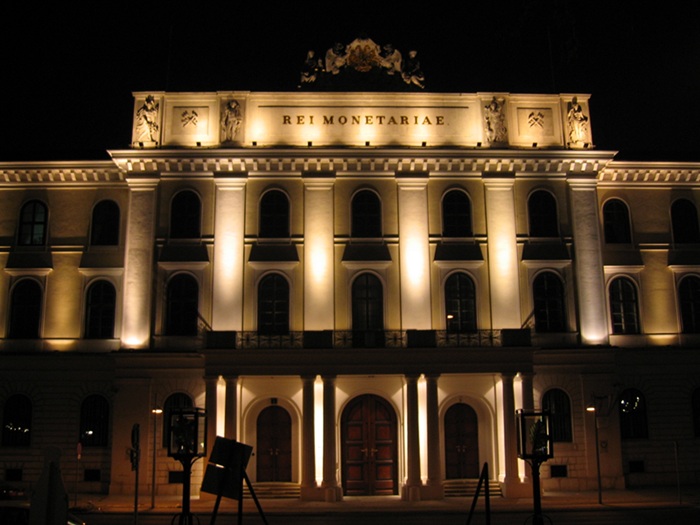
The Austrian Mint dates itself from 1194, when the first instalment of Richard the Lionheart’s ransom, twelve tonnes of silver, was paid to Duke Leopold V of Austria, who put it straight to use striking coins. The first written record of a mint on the Wollzeile in central Vienna comes in 1371. In 1752 the operation moved to the Winter Palace of Prince Eugene on the Himmelpfortgasse, and in the 1830s Kaiser Franz I ordered the purpose-built mint on Am Heumarkt that it still occupies today.
By the 1850s it was the leading mint of the Habsburg Empire, and from 1918 it was the only mint in the new Austrian republic. It struck the schilling from 1925, the Reichsmark from 1938 to 1945, the schilling again from 1945 until 2001, and Austria’s euro coinage since.
The modern company dates from the end of the 1980s. Ownership passed to the Oesterreichische Nationalbank in 1988 and the business was incorporated as Münze Österreich AG the year after, the same year the Vienna Philharmonic was launched.
One piece of that history still shows up on the products. For years the Mint held a substantial stake in Argor-Heraeus, alongside Heraeus, Commerzbank and the refinery’s own management. Heraeus bought out every share it did not already own in 2017, and the Austrian Mint sold up along with the others. The commercial relationship outlasted the shareholding: Argor-Heraeus still manufactures Münze Österreich’s gold bars.
What the Austrian Mint Produces
The Mint’s output falls into three parts. There is the statutory business of supplying Austria’s circulating euro and cent coinage, which came to 55.7 million coins in 2025. There is the collector side, which covers commemorative issues in gold, silver, niobium and base metals, medals, and blanks supplied to other mints. And there is the investment business, which is where almost all the revenue sits: 531,000 ounces of gold, 3.9 million ounces of silver and 22,000 ounces of platinum sold in 2025.
The Vienna Philharmonic
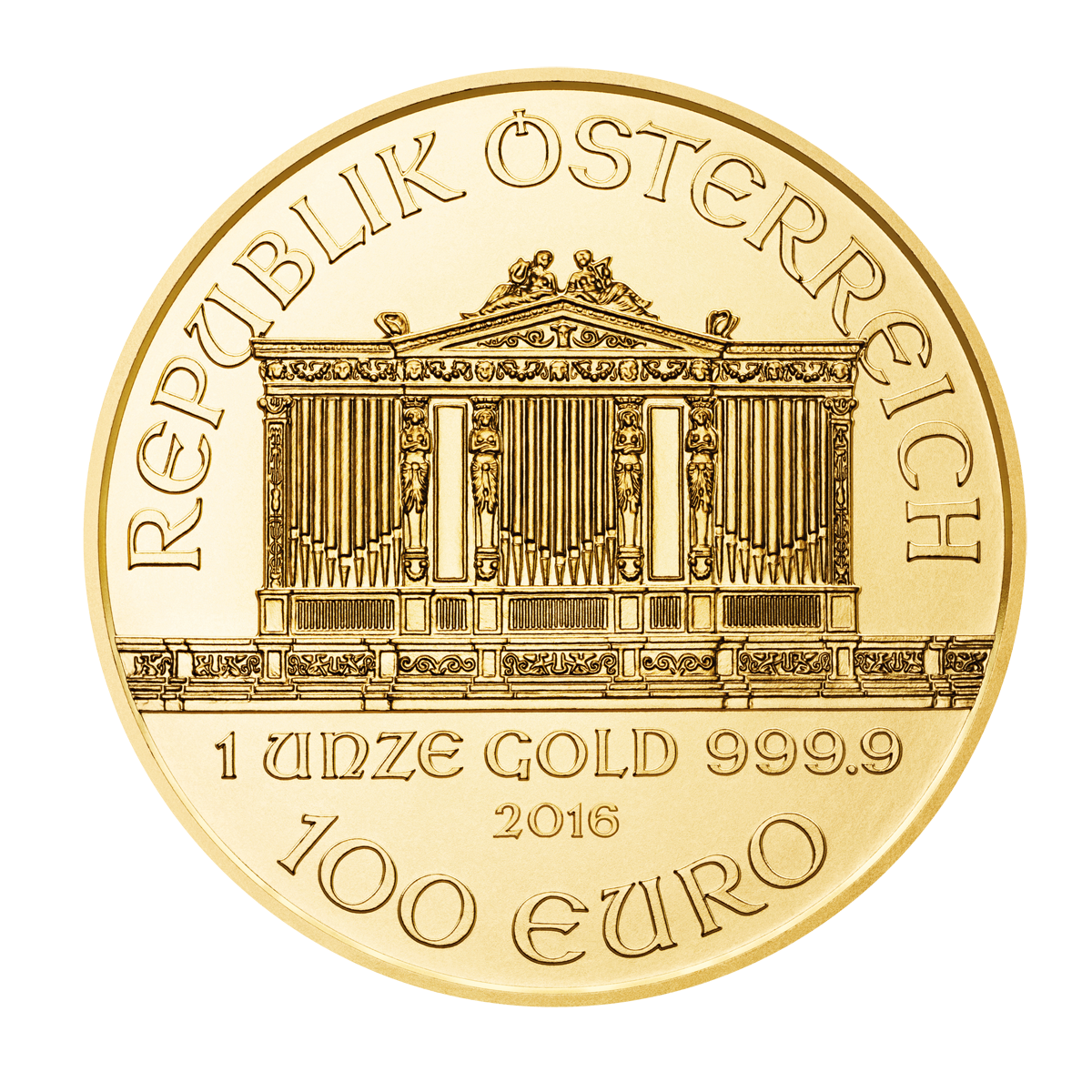
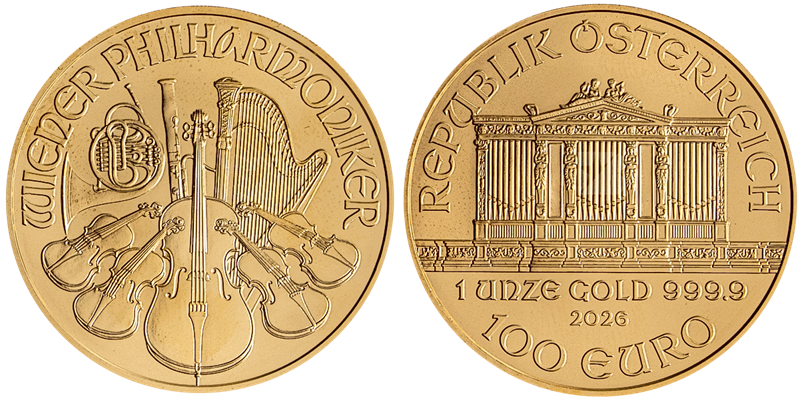
The Philharmonic went on sale on 10 October 1989 in gold, and was joined by a silver version in February 2008 and a platinum one in February 2016. The design has never changed. One side carries the great organ of the Musikverein’s Golden Hall, home of the Vienna Philharmonic orchestra, along with the country name, the weight, the fineness and the face value. The other carries a group of the orchestra’s instruments, a Vienna horn, a bassoon, a harp, four violins and a cello. Both faces are the work of Thomas Pesendorfer, who is credited on every Philharmonic the Mint has struck.
Every coin is legal tender in Austria and carries a face value in euros.
| Coin | Fineness | Face value | Diameter |
|---|---|---|---|
| Gold, 1 oz | 999.9 | €100 | 37 mm |
| Gold, 1/2 oz | 999.9 | €50 | 28 mm |
| Gold, 1/4 oz | 999.9 | €25 | 22 mm |
| Gold, 1/10 oz | 999.9 | €10 | 16 mm |
| Gold, 1/25 oz | 999.9 | €4 | 13 mm |
| Silver, 1 oz | 999 | €1.50 | 37 mm |
| Platinum, 1 oz | 999.5 | €100 | 37 mm |
| Platinum, 1/25 oz | 999.5 | €4 | 13 mm |
The coins were denominated in Austrian schillings until 2001 and in euros from 2002, so a Philharmonic struck before the changeover carries a schilling face value. That is a dating detail rather than a problem, and the gold content is identical.
By the Mint’s own count, around 13.8 million one ounce gold Philharmonics had been sold worldwide by the end of 2023. It has not published an updated figure since.
Gold Bars and Other Coins
The Mint sells gold bars from 1 gram to 1 kilogram under its own name, and as the previous section explained, they are made for it in Switzerland by Argor-Heraeus and PAMP.
Alongside the bullion range the Mint restrikes Austria’s historic trade coins, the gold ducat, gulden and corona, each carrying the date it last circulated rather than the year it was made, and the silver Maria Theresa thaler, which has been struck with the date 1780 for well over two centuries.
What We Stock
At BullionStar we carry the gold Philharmonic in 1 oz, 1/2 oz, 1/4 oz and 1/10 oz, in the current year and in a range of earlier dates, the silver Philharmonic in 1 oz across many years, and the platinum Philharmonic in 1 oz. If the year matters less to you than the price, our various-year 1 oz gold Philharmonics, 1 oz silver Philharmonics and 1 oz platinum Philharmonics are usually the cheaper way in. Browse our full range of gold coins, silver coins, and platinum coins.
How to Identify a Genuine Vienna Philharmonic
The Philharmonic range doesn’t include security technology. There are no radial machined lines, no micro-engraved marks, no serial numbers, no assay card, no app and no database. What it has is a complicated design, a tightly controlled set of dimensions, and the physics of the metal inside it. That turns out to be enough for most purposes, but it means checking a Philharmonic is a matter of measurement rather than of scanning something.
The Austrian Mint’s own position is that the design does the work. Its marketing director has said that the coin’s very complex strike pattern makes it close to impossible to counterfeit profitably, because reproducing it convincingly would take more work than the gold is worth. That is the Mint’s view rather than an independent finding, but it is consistent with the fact that the Philharmonic does not appear in the published counterfeit-detection studies that cover several other major bullion coins. Less common is not never, though, and the checks below are worth running.
What the Coin Should Measure
All three one ounce Philharmonics are exactly 37 mm across, which catches people out. Diameter alone will not tell you whether you are holding gold, silver or platinum, and it will not tell you whether the coin is real. Thickness will, because it is a direct consequence of the density of the metal.
| One ounce coin | Diameter | Thickness | Gross weight |
|---|---|---|---|
| Gold | 37.00 mm | 2.00 mm | 31.103 g |
| Silver | 37.00 mm | 3.20 mm | 31.103 g |
| Platinum | 37.00 mm | not reliably published | 31.103 g |
The fractional gold coins run 28 mm for the half ounce, 22 mm for the quarter, 16 mm for the tenth and 13 mm for the 1/25 ounce, with gross weights of 15.552 g, 7.776 g, 3.121 g and 1.244 g.
The Austrian Mint publishes diameters but has never published a thickness for any Philharmonic in any metal, so these figures come from various online sources. For the platinum coin those sources disagree badly, from 1.0 mm to 2.0 mm. If you are checking a platinum Philharmonic, measure it against one you know to be genuine rather than against a published figure.
Why thickness matters more than weight is straightforward. A counterfeiter can hit 31.103 g easily enough with a base metal core, and can hit 37 mm easily enough too. Hitting both at once while also being 2.00 mm thick requires the coin to have the density of gold, and nothing cheap does.
The Design and the Edge
One face carries the great organ of the Musikverein’s Golden Hall, with the country name, the weight, the fineness and the face value around it. The other carries the orchestra’s instruments, a Vienna horn, a bassoon, a harp, four violins and a cello. The design has not changed since 1989 in gold, 2008 in silver or 2016 in platinum, so the only thing that varies between years is the date.
The edge is the most useful free check, because it differs by metal. The gold Philharmonic has a reeded edge. The silver Philharmonic has a plain, smooth one. A one ounce coin that looks like silver and has a reeded edge, or looks like gold and has a smooth one, is wrong. There is no edge lettering on any Philharmonic.
What It Should Not Come With
Philharmonics are sold loose. The Mint ships them in tubes, ten to a tube for the one ounce gold and platinum, twenty for the silver and the fractional gold, and its own product pages describe the bullion coins as supplied without packaging.
So there is no specific Austrian Mint capsule, no assay card, no certificate of authenticity and no serial number to match against anything. If a Philharmonic arrives sealed into an official-looking card carrying a certificate and a number, that packaging did not come from Vienna. It may simply be a dealer’s own presentation, which is common and harmless, but it is not evidence of anything, and it should not raise your confidence in the coin.
How the Philharmonic Compares
| Bullion coin | What the owner can check |
|---|---|
| Maple Leaf (Royal Canadian Mint) | Radial lines and a micro-engraved mark, visible with magnification. The database check is dealer-only |
| Kangaroo (Perth Mint) | A micro-engraved letter on gold coins from 2019 |
| Vienna Philharmonic (Austrian Mint) | Design, dimensions, weight and edge |
| Britannia (Royal Mint) | Four features from 2021 onwards: a latent image shifting between padlock and trident, surface animation on the waves, micro-text, and tincture lines |
If built-in verification matters to you, the Philharmonic is the plainest, and that is a fair reason to prefer another option. What the Philharmonic offers instead is a design that is genuinely difficult to reproduce and, as the prices section below shows, no premium charged for a security feature.
Whatever the coin, weigh and measure it. A counterfeit that reproduces the design convincingly is usually wrong on weight, thickness or both, and calipers and a scale reading to a hundredth of a gram remain the most reliable cheap check available. Our guides on how to test gold and how to test silver cover the methods in more detail, from density and dimensions through to ultrasound and X-ray fluorescence.
Austrian Mint Prices and Premiums
Every Philharmonic is priced from the live spot price of the metal it contains, plus a premium covering minting, packaging and distribution. The metal price moves all day and the premium is the part the mint and the dealer control.
On the headline product the Philharmonic is unremarkable in the best sense. A 2026 one ounce gold Philharmonic carried a premium of 4.66%, against 4.04% for a UK Britannia, 4.24% for a Canadian Maple Leaf and 3.94% for a plain one ounce Metalor gold bar. A legal tender coin from a national mint costs about seven tenths of a percentage point more than an anonymous bar of the same weight, which is a small price for a piece that any dealer in the world will recognise on sight.
Silver tells a different story, because premiums are a much larger share of a cheap metal. Comparing 2026 dated one ounce coins from our range at the same moment:
| 2026 one ounce silver coin | Premium over spot |
|---|---|
| UK Britannia (Royal Mint) | 7.0% |
| Vienna Philharmonic (Austrian Mint) | 8.0% |
| Canadian Maple Leaf (Royal Canadian Mint) | 8.0% |
| Australian Kangaroo (Perth Mint) | 8.0% |
| American Eagle (US Mint) | 16.4% |
The Philharmonic sits exactly level with the Maple Leaf and the Kangaroo, marginally behind the Britannia, and at half the premium of the American Eagle. For a coin with no security features and no collector premium, that is the right place to be.
Platinum is the outlier. A 2026 one ounce platinum Philharmonic carried a premium of 15.2%, which reflects a far thinner market rather than anything about the coin. Platinum is a legitimate diversification, but it is not a cheap way to own metal.
One practical saving worth knowing. Our mixed-year listings, where you get a genuine Philharmonic but not a guaranteed date, are consistently cheaper than the current year. At the same moment the mixed-year gold coin carried 4.27% against 4.66% for the 2026 coin, and the mixed-year silver 6.03% against 8.03%. On silver that is two full percentage points for accepting a coin that may be a few years old, and since the gold or silver content is identical, there is no reason to pay for the date unless you want it.
You can check today’s prices on our gold price and silver price pages, and current buy-back rates on our sell gold and silver page.
Frequently Asked Questions
What is the Austrian Mint?
The Austrian Mint (officially Münze Österreich) is Austria’s national mint. It produces circulating currency, as well as bullion coins, such as the famous Philharmonic range. Münze Österreich is a wholly owned subsidiary of the Oesterreichische Nationalbank, which is in turn wholly owned by the Republic of Austria.
Is the Vienna Philharmonic a good investment coin?
The Vienna Philharmonic tracks the live metal price, and is competitively priced as a bullion coin. For investors looking for a recognised design, it offers a good choice.
What purity is the Gold Philharmonic?
The gold Philharmonic coins are 999.9 fine gold (24 karat). Silver Philharmonics are 999 fine silver, and platinum 999.5 platinum. All three are pure enough to qualify for GST exemption under Singapore’s Investment Precious Metals scheme.
Is the Philharmonic available in silver and platinum?
Yes, the Philharmonic range is available in silver and platinum as well as gold. Since 2016 the Austrian Mint has produced annual releases in the three primary investment precious metals.
How old is the Austrian Mint?
The Austrian Mint is over 800 years old, and dates itself from 1194. This makes it one of the oldest mints in Europe. The modern company, Münze Österreich AG, was incorporated in 1989.
Where can I buy Philharmonics in Singapore?
BullionStar stocks Philharmonic coins in gold, silver, and platinum, including our various year ranges, and specific years. Silver and platinum are available at 1 oz sizes, with gold available in 1 oz and fractional ranges.
Buying and Selling Austrian Mint Bullion
The Austrian Mint is one of Europe’s longest running mints, and the Philharmonic represents the leading bullion coin denominated in euros. The consistent design, and no-frills packaging puts it squarely in the bullion category, with premiums to match.
All three Philharmonics clear Singapore’s Investment Precious Metals thresholds, so gold, silver and platinum Philharmonics all carry no GST on Singapore deliveries, and Singapore levies no capital gains tax when you sell. When you come to sell we buy Philharmonics back at a live quoted price whether or not you bought them from us, and metal held in our vault can be sold back online without being shipped anywhere first.
Looking to add Philharmonic coins to your stack? Browse our full range of gold coins, silver coins, and platinum coins, including the Philharmonic. Our products are available to be shipped internationally, stored in our high-security vault, or collected from our Bullion Center in Singapore.
Subscribe to Gold University Articles
Copyright Information: BullionStar permits you to copy and publicize articles or information from the BullionStar Gold University provided that a link to the article's URL or to https://bullionstar.com is included in your introduction of the article or blog post together with the name BullionStar. The link must be target="_blank" without re="nofollow". All other rights are reserved. BullionStar reserves the right to withdraw the permission to copy content for any or all websites at any time.